
How to Track Marketing ROI in 2026: Attribution, ROAS & First-Party Data
Learn how to track marketing ROI in 2026 using attribution models, ROAS, and first-party data. Discover AI-powered strategies to improve campaign performance, optimize ad spend, and drive better business growth.
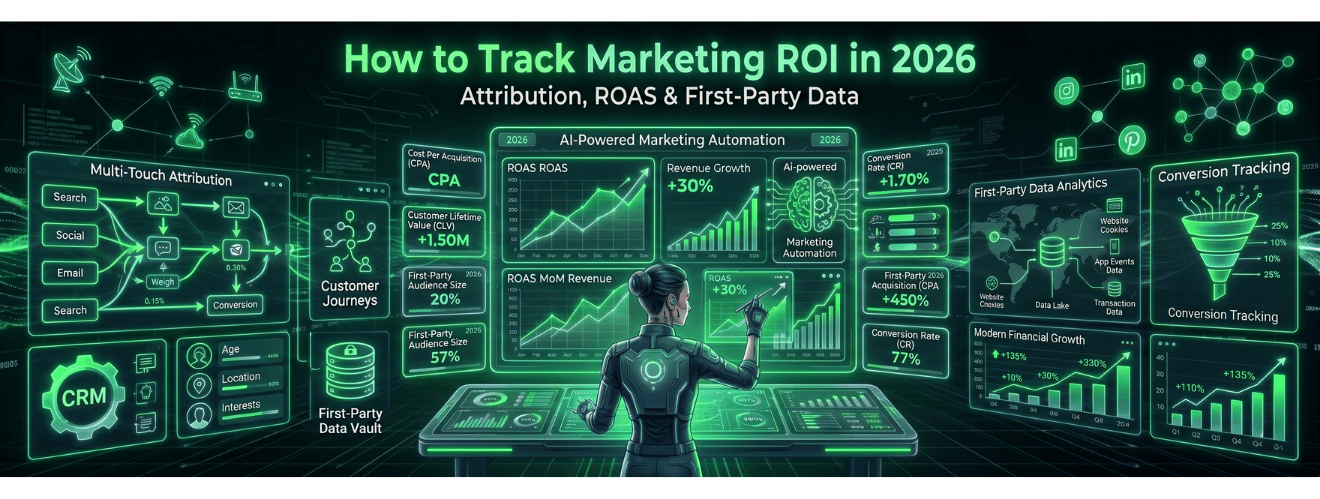

Marketing without measurement is just guesswork. With rising ad costs, the end of third-party cookies, and increasing pressure to justify every spend, knowing how to accurately track marketing ROI has never been more critical.
Yet most businesses still struggle to answer one fundamental question: Which campaigns are actually driving revenue?
This guide covers everything you need — GA4 setup, attribution models, ROAS calculation, and a future-proof first-party data strategy.
Why ROI Tracking is Harder in 2026
Several changes have made tracking more complex:
Cookie deprecation: Third-party cookies are gone from major browsers
iOS privacy updates: Apple's ATT framework has limited mobile tracking
Multi-touch journeys: Customers interact with 6–8 touchpoints before converting
Walled gardens: Google, Meta, and others report conversions differently, creating data gaps
Despite these challenges, the brands winning in 2025 have invested in robust, privacy-compliant measurement infrastructure.
Step 1: Set Up GA4 Correctly
Google Analytics 4 (GA4) is the foundation of modern marketing measurement. Its event-based tracking model is far more flexible than Universal Analytics.
Key GA4 setup steps:
Define conversion events: Map your goals — purchase, generate_lead, book_demo, sign_up
Link to Google Ads: Import GA4 conversions for smarter bidding
Set up cross-domain tracking: Prevent session breaks across multiple domains
Implement server-side tracking: Bypass ad blockers and browsers to improve data accuracy by 15–30%
Export to BigQuery: For advanced analysis and custom reporting
Step 2: Choose the Right Attribution Model
Marketing attribution assigns credit to the touchpoints that led to a conversion. The wrong model distorts your entire view of what's working.
Last-Click: All credit goes to the final touchpoint. Simple, but ignores everything that built awareness before the final click.
First-Click: Credit goes to the first touchpoint. Good for understanding awareness drivers, but neglects conversion-stage channels.
Linear: Credit is split equally across all touchpoints. Balanced, but treats every channel as equally valuable.
Time-Decay: More recent touchpoints get more credit. Useful for short sales cycles.
Data-Driven (Recommended): Machine learning assigns credit based on how each touchpoint actually contributed to conversions. Most accurate, but requires 300+ monthly conversions to work effectively.
Use data-driven attribution in both GA4 and Google Ads wherever possible. It gives the clearest picture of your true channel performance.
Step 3: Calculate and Improve ROAS
ROAS (Return on Ad Spend) is the core performance marketing metric:
ROAS = Revenue Generated ÷ Ad Spend
Example: ₹1,00,000 spend → ₹4,00,000 revenue = 4x ROAS
ROAS Benchmarks by Industry:
IndustryTarget ROASeCommerce (high margin)4x – 8xeCommerce (low margin)8x – 15xLead Generation3x – 6xSaaS2x – 4x
How to improve ROAS:
Tighten audience targeting to high-intent segments
Improve landing page conversion rates
Increase average order value through upsells
Pause underperformers and scale winners
Improve creative quality and ad relevance
Step 4: Build a First-Party Data Strategy
With third-party cookies gone, first-party data — collected directly from your customers — is your most valuable marketing asset.
How to build it:
Capture emails and phone numbers through lead magnets, quizzes, and loyalty programs
Use Meta Conversions API (CAPI) and Google Enhanced Conversions to send first-party signals server-side
Build custom audiences from your customer list for retargeting and lookalike modeling
Personalize ad creative and email campaigns using behavioral data from your CRM
Step 5: Build a Centralized Performance Dashboard
Bring all your data into one place using Google Looker Studio (free). Connect GA4, Google Ads, Meta Ads, and email platforms into a single real-time dashboard.
Metrics to track:
ROAS by channel, campaign, and creative
CPA by funnel stage
Revenue attributed to each channel
CAC vs. LTV ratio
Conversion rate by landing page
Conclusion
Tracking marketing ROI in 2025 requires a layered approach: accurate GA4 setup, smart attribution, ROAS optimization, and first-party data collection. Brands that invest in their measurement infrastructure now will have a lasting competitive advantage as privacy regulations continue to evolve.
Don't let poor tracking cost you growth. Build your measurement stack right — and let data drive every decision.
Need help with your performance marketing tracking? Talk to our experts for a free analytics audit.



Your full-service digital growth agency. We help brands across India grow faster, smarter, and more profitably online.
Services
SEO
Digital Marketing
Performance Marketing
Social Media Management
Web Development
SEM / Google Ads
© 2021 Hype & Reach. All rights reserved.